
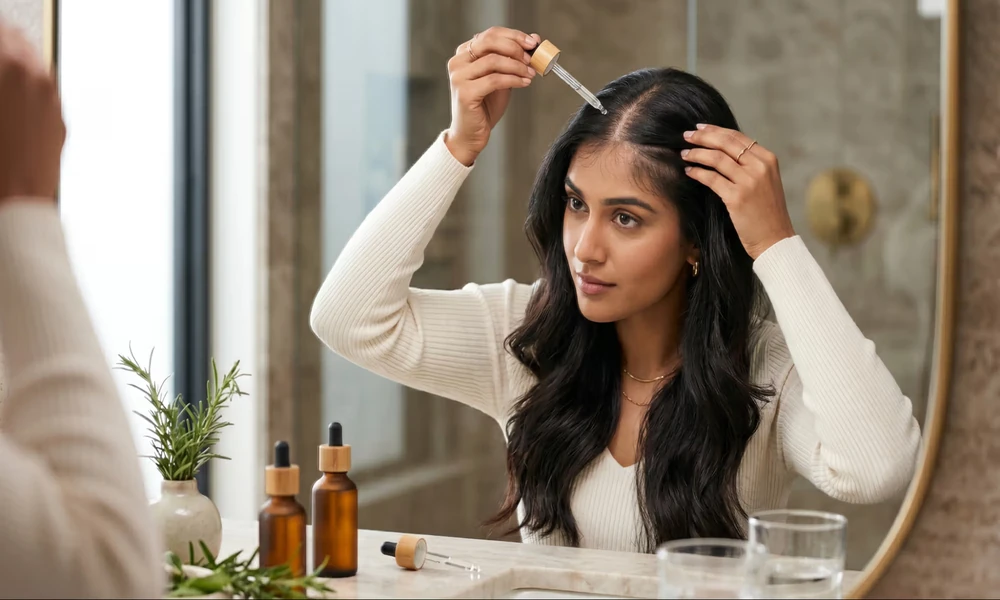
Hair thinning after menopause can literally feel very different from the hair fall you may have experienced earlier in life.
You may notice more hair on your pillow, a thinner ponytail, increased shedding when you are washing your hair or even a widening part on the scalp.
Naturally, one of the first things many women look for is the best anti hair fall shampoo after the menopause phase.
A good shampoo can totally be part of your haircare routine. Menopause-related hair thinning is very often influenced by hormonal changes, ageing of the hair follicles as well as other factors.
So, shampoo should only be viewed as scalp and hair care rather than a complete treatment for hair loss.
Female pattern hair loss commonly begins in midlife. It becomes more common after menopause.
Hair-loss shampoos may help hair look fuller or reduce breakage but they cannot regrow hair or even prevent progressive hair loss.
So, what should you look for in a shampoo for hair after menopause?
Why Does Hair Fall Increase After Menopause?
Menopause brings significant hormonal changes which is particularly a decline in oestrogen.
Oestrogen contributes to hair growth, fullness as well as density. As its levels decline then this is when some women notice that their hair becomes thinner, drier or less dense.
You may notice all these:
- Increased hair shedding
- A wider centre part
- Thinning around the crown
- A smaller or thinner ponytail
- Finer individual strands
- Drier or more brittle hair
- A receding hairline in some cases
Menopause is not necessarily the only main reason.
Hair loss can also be associated with many factors. These are thyroid problems, nutritional deficiencies, stress, medications, scalp conditions as well as female pattern hair loss. This is why persistent thinning should not automatically be blamed on menopause.
Can Shampoo Stop Post-Menopausal Hair Fall?
This is one of the most important questions to answer in a very realistic manner.
An anti hair-fall shampoo can totally support scalp and hair health but it cannot correct the hormonal changes responsible for menopause-related hair thinning.
The best Shampoo for hair fall can help by:
- Keeping the scalp clean
- Removing excess oil and buildup
- Improving hair manageability
- Reducing some forms of breakage
- Helping dry hair retain moisture
- Supporting a comfortable scalp environment
But if the hair follicles are becoming thinner in a very progressive manner then simply changing shampoos may not stop the process.
Hair-loss shampoos can totally make hair look fuller and lessen breakage but they cannot regrow hair or prevent hair loss from worsening. This is why choosing a shampoo should be only one part of a post-menopause hair-care routine.
Top 3 Anti-Hair Fall Shampoos After Menopause
1. Tinfal Anti Hair Fall Shampoo
Tinfal Anti Hair Fall Shampoo is very expertly formulated for haircare. It is specifically made round hair-fall concerns. The shampoo is power-packed with Biotin, Rosemary Oil, Saw Palmetto, Red Onion Extract as well as Caffeine.
The total combination makes it an option for women who are actually looking for a multi-ingredient anti-hair-fall shampoo rather than a basic cleansing product.
Key ingredients
Saw Palmetto
Saw palmetto is a botanical ingredient. It has been studied in relation to androgen-related hair thinning. It is not presented as a proven treatment for post-menopausal hair loss.
Caffeine
Caffeine is very commonly included in hair-care products which are expertly designed for thinning as well as shedding concerns. Topical caffeine is promising but does not establish that every caffeine shampoo will regrow hair in a permanent way.
Rosemary Oil
Rosemary oil is widely used in scalp-care products. It has been investigated for hair-loss applications.
Red Onion Extract
Red onion extract is used in cosmetic hair formulations as a scalp-care ingredient.
Biotin
Biotin plays a very crucial role in normal keratin production. Additional biotin does not necessarily improve overall hair growth in people who are not deficient.
For women after menopause who actually want a shampoo with several hair-care actives in one formula then Tinfal Anti Hair Fall Shampoo can be considered as part of a broader hair-care routine.
2. Minimalist Anti-Dandruff Shampoo 3.5%
Not every woman who is experiencing hair fall after menopause actually needs a traditional anti-hair-fall shampoo. Sometimes, the bigger issue is the scalp itself.
Menopausal usually changes. It can also be accompanied by changes in skin as well as scalp dryness. Some women may continue to experience oily scalp, dandruff or buildup.
Minimalist Anti-Dandruff Shampoo 3.5% is power-packed with Climbazole, Piroctone Olamine and Salicylic Acid.
If you have:
- Visible flakes
- Itchy scalp
- Excessive scalp buildup
- Oily scalp with dandruff
- Scalp discomfort
Then managing the scalp condition may be more relevant than choosing a shampoo simply because it says hair growth on the label. This is primarily an anti-dandruff/scalp-care shampoo, not a treatment for menopause-related follicular hair loss.
If your scalp is very dry or sensitive then make sure to consider whether exfoliating ingredients such as salicylic acid are suitable for you.
3. The Derma Co Peptide-Stem Cell Hair Fall Control Shampoo
The Derma Co Peptide-Stem Cell Hair Fall Control Shampoo is expertly formulated with ingredients such as Copper Peptide, plant stem-cell extracts as well as Anagain. It has conditioning ingredients such as niacinamide and panthenol. The shampoo is ideal to be used for reducing hair fall and improving hair as well as scalp health.
It is designed around a combination of cleansing and conditioning ingredients. The formula also contains ingredients which are highly intended to improve hair feels as well as manageability.
For post-menopausal women who are dealing with weak, brittle or thinning-looking hair then this type of conditioning-focused anti-hair-fall formulation may be worth considering.
How to Choose Between the Three?
The best choice totally depends on your actual concern.
Choose Tinfal if:
You want a dedicated anti-hair-fall shampoo with multiple ingredients such as caffeine, saw palmetto, rosemary oil, red onion extract as well as biotin.
Consider Minimalist if:
Your hair concerns are very closely associated with dandruff, flakes, itching or even scalp buildup.
Consider The Derma Co if:
Your hair feels weak, brittle, dry or thinning. You prefer a peptide-focused formulation which is power-packed with conditioning ingredients.
The very crucial point is that these shampoos are not interchangeable treatments for every type of hair loss.
Wrapping Up
Hair fall after menopause is very common to be experienced by women all around the world. It should not automatically be dismissed as something you simply have to live with.
Hormonal changes can totally affect hair growth, density as well as texture. Female pattern hair loss becomes more common during midlife.
A suitable anti-hair fall shampoo after menopause can totally help maintain scalp hygiene and reduce breakage. It also makes thinning hair easier to manage.
Among the options discussed, Tinfal Anti Hair Fall Shampoo totally offers a multi-ingredient formula which is highly power-packed with Biotin, Rosemary Oil, Saw Palmetto, Red Onion Extract and Caffeine.
Minimalist Anti-Dandruff Shampoo 3.5% is more focused on dandruff, flakes, itching as well as scalp buildup. The Derma Co Peptide-Stem Cell Hair Fall Control Shampoo works by combining peptides and plant-derived ingredients all with conditioning components for hair as well as scalp care.
The right shampoo for hair supports your hair-care routine. It does not necessarily treat the reason your hair is thinning. If your part is widening or even your overall density is decreasing in a very steady manner then getting the cause identified early is more useful than continuously switching shampoos.

Comments are closed.