
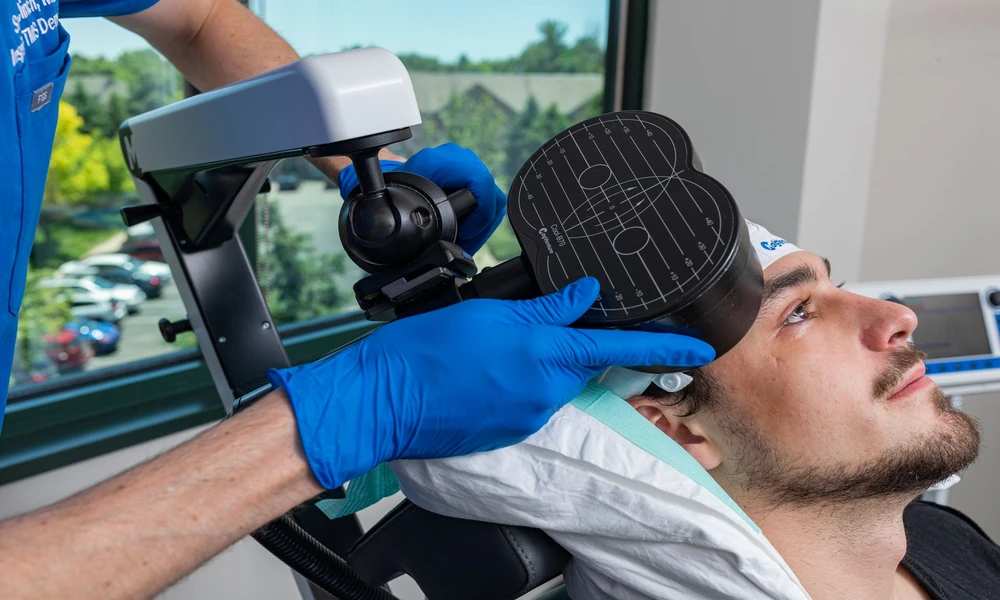
Deep TMS differs from standard TMS mainly in how far and how widely its magnetic field reaches into the brain. Both are noninvasive, outpatient procedures that use magnetic pulses to stimulate brain regions involved in mood regulation. The distinction comes down to coil design, and that design shapes how clinicians plan treatment for patients whose depression has not responded to medication.
TMS has held FDA clearance for major depressive disorder since 2008 (U.S. Food and Drug Administration).
What is transcranial magnetic stimulation?
Transcranial magnetic stimulation is a brain stimulation therapy that uses a magnetic coil placed against the scalp to induce small electrical currents in targeted areas of the cortex. Patients remain awake throughout each session, require no anesthesia, and can typically drive themselves home afterward.
Where TMS fits among brain stimulation therapies
TMS belongs to a group of brain stimulation therapies used when standard treatments have not produced adequate relief (National Institute of Mental Health). TMS is most often considered for major depressive disorder after a patient has tried 2 or more antidepressants without sufficient improvement.
How deep TMS is delivered in outpatient practices
Deep TMS is delivered in outpatient practices as a standalone course or alongside psychiatry and therapy, and St. Louis patients can now receive it on BrainsWay H-coil technology (Lakeside Behavioral Health).
How does the coil design separate deep TMS from standard TMS?
The coil design separates the two approaches. Standard TMS uses a figure-eight coil that produces a focused field reaching roughly the outer surface of the cortex. Deep TMS uses an H-coil, a helmet-style design that produces a broader field capable of reaching deeper and wider brain structures.
Standard TMS coil characteristics
- Focused, figure-eight coil shape
- Shallow field concentrated near the cortical surface
- Precise targeting of the left dorsolateral prefrontal cortex
- FDA clearance for major depressive disorder since 2008
Deep TMS coil characteristics
- Helmet-shaped H-coil fitted over the head
- Broader field that stimulates a larger volume of tissue
- Positioning that is less sensitive to minor head movement
- FDA clearance for major depressive disorder in 2013 and for obsessive-compulsive disorder in 2018
Why does treatment-resistant depression call for different options?
Treatment-resistant depression calls for different options because the medications that help some patients leave others with persistent symptoms or side effects they cannot tolerate. Depression is a common but serious mood disorder that affects how a person feels, thinks, and handles daily activities (National Institute of Mental Health).
Why repeated medication trials add up
When a patient has cycled through several medication trials, each trial can take 6 to 8 weeks to evaluate. That timeline adds up to months of continued symptoms. Brain stimulation offers a separate mechanism that does not depend on the same pathways antidepressants act on.
What does a typical deep TMS treatment course look like?
A typical deep TMS course involves daily sessions, 5 days per week, over approximately 4 to 6 weeks. Individual sessions for depression generally run about 20 minutes, and some protocols are shorter.
Stages of a standard deep TMS course
- Initial psychiatric evaluation to confirm diagnosis and treatment history
- Motor threshold mapping to calibrate the device to the individual patient
- Daily treatment sessions across the full course
- Periodic symptom assessments using standardized rating scales
- Tapering or maintenance sessions when clinically appropriate
What side effects do patients report with TMS?
Patients most commonly report scalp discomfort at the coil site and mild headaches during the first week of treatment. These effects usually decrease as sessions continue. Other reported effects include:
- Tapping or clicking sensations during pulses
- Temporary facial muscle twitching
- Lightheadedness immediately after a session
- Seizures, which are rare and screened for during intake
Because the procedure requires no sedation, patients return to work, school, or family responsibilities the same day. That feature makes TMS practical for working professionals who cannot step away from daily obligations.
Who is a candidate for deep TMS?
Candidates for deep TMS are adults diagnosed with major depressive disorder who have not achieved adequate relief from antidepressant medication. A psychiatric provider makes the final determination after reviewing medical history and current symptoms.
Factors that affect candidacy
- Documented history of medication trials
- Absence of non-removable metal implants in or near the head
- Seizure history and neurological risk factors
- Current medications that may lower seizure threshold
- Ability to attend daily sessions for the full course
Insurance plans often require documentation of prior medication trials before approving coverage. Patients benefit from gathering pharmacy records and prior treatment notes before their first consultation.
How is progress measured during a TMS course?
Progress during a TMS course is measured with standardized depression rating scales administered at intake, at regular intervals during treatment, and at the end of the course. Common tools include the PHQ-9 and the Hamilton Depression Rating Scale.
How scores guide protocol decisions
Clinicians compare scores across time to decide whether to continue, extend, or adjust the protocol. Patients often notice changes in sleep, energy, or motivation before they notice changes in mood, and tracking those early shifts helps set expectations for the weeks that follow.
How do patients choose between deep TMS and standard TMS?
Patients choose between the two based on clinical recommendation, device availability in their area, and insurance coverage. Both approaches have FDA clearance for major depressive disorder, and a psychiatrist can explain which device a clinic uses and why. Questions worth asking during a consultation include:
- Which coil type does the clinic use?
- How many sessions does the recommended protocol include?
- How will progress be measured during treatment?
- What happens if symptoms return after the course ends?
- Does the clinic coordinate TMS with medication management and therapy?
Deep TMS gives patients with treatment-resistant depression another evidence-based path when medication alone has not been enough. Understanding how the coil design works helps patients ask informed questions and set realistic expectations before starting treatment.

Comments are closed.