
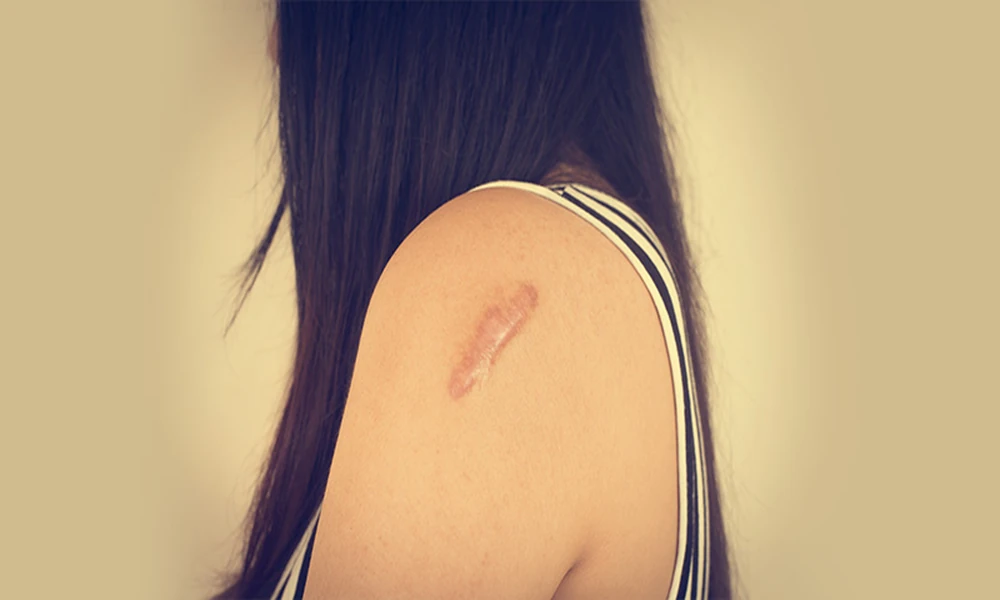
Keloids are one of the more unpredictable outcomes of skin healing. They form when the skin’s healing process produces too much collagen, growing out of the original wound’s borders.
This leaves a raised, firm scar that extends into healthy skin, not just the wound area. It could sometimes grow for months or years after the initial injury has healed.
Keloids can form after any skin injury, including:
- Surgery
- Piercings
- Acne
- Burns
- Vaccinations.
They can even form after minor scratches. Especially in people genetically predisposed to developing them.
The earliest signs
The first sign often appears a few weeks after a skin injury. The healing spot starts to feel:
- Itchy
- Tender
- Mildly painful.
It also lingers longer than the usual healing process. This ongoing irritation is the first indication that the inflammatory healing process is not shutting off properly.
Other signs include:
- Some discoloration spreading away from the wound edges. It could be mild pink or red.
- The skin around the wound is warmer than the surrounding skin.
The scar may not yet look dramatically different from a normal healing wound at this very early stage. This is why the sensation is a more reliable early indicator.
How it appears as it progresses
As time passes, the visual signs become more distinct.
- The scar starts to lift from the skin surface.
- Edges start to grow sideways past the original wound.
- The texture becomes firmer and rubbery.
- The color darkens. It could go from pink or red to a deep brown, purple, or a dark reddish tone. This depends on the skin tone of the person.
- The shape is usually irregular.
- The scar may become smooth and shiny as it expands.
These visual events, along with continued itching or discomfort, are good signs that the keloid formation is in progress.
Some people have a high risk
You can keep a closer eye on your healing wounds by being aware of unique risk factors. You are at a high risk of getting keloids if you are:
- Aged between 10 and 30
- Have a darker skin tone
- Have a personal or familial history of keloid formation
- You have previously developed a keloid.
Individuals who are more susceptible to these scars should closely monitor their wounds. They can be triggered even by minor skin injuries, such as:
- A piercing
- Small cut
- Acne lesion.
Consult a clinician if you spot any of the mentioned warning symptoms.
Early intervention helps
A keloid responds to treatment better if it is identified early. Early-stage keloids have reduced density and vascularity. So, they respond better to treatments that disrupt excess collagen production.
Medical treatment for keloids includes:
- Corticosteroid injections
- Silicone sheeting
- Compression therapy
- Laser therapy
- Surgical excision
- Cell-based regenerative support.
These treatments are much more effective on newly formed keloids rather than on fully formed keloids.
The takeaway
Do not wait until a keloid establishes itself fully. Seek professional treatment if you notice the above signs. It is much easier to control keloids if detected early.

Comments are closed.